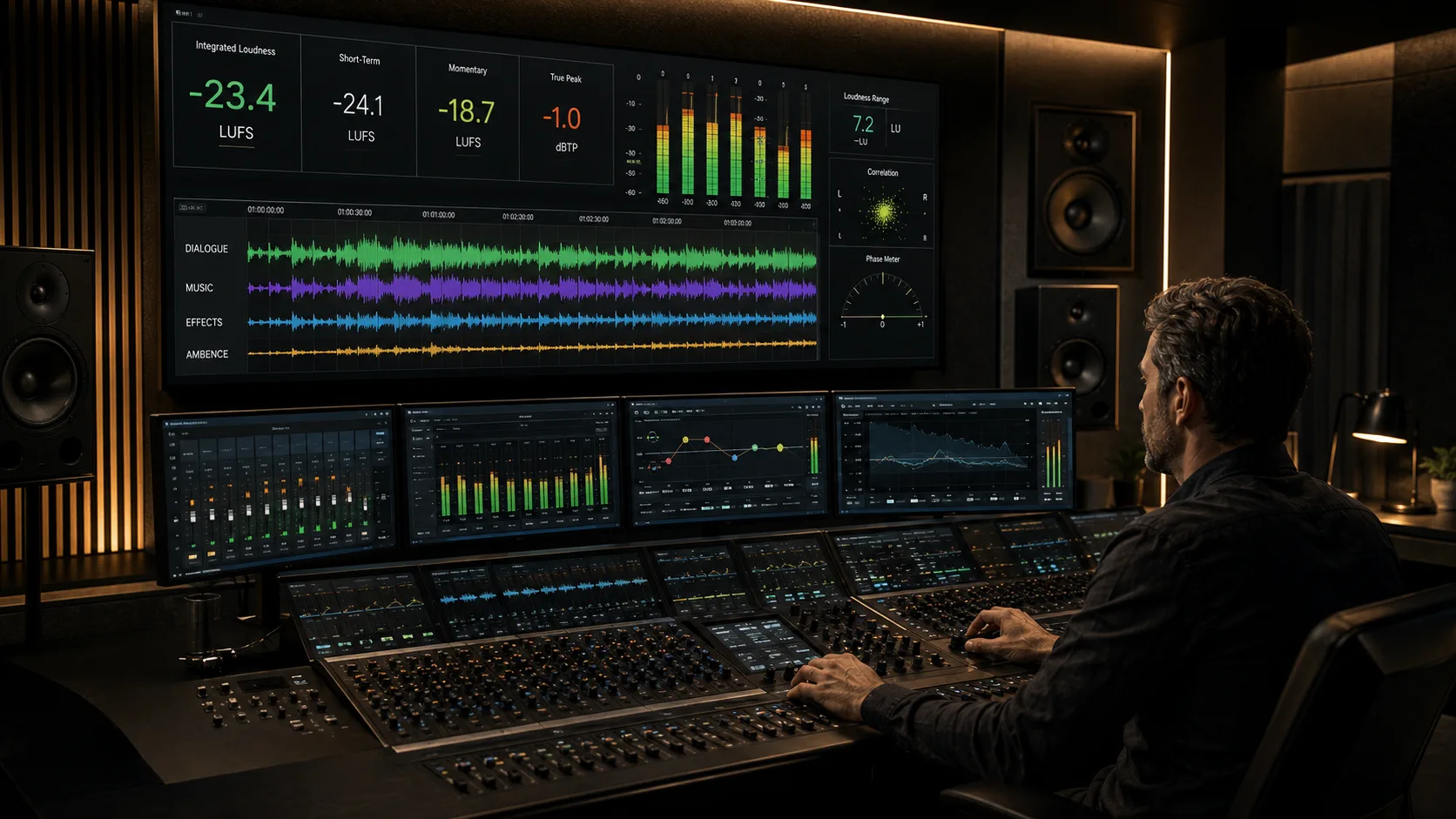
Loudness standards exist because audiences change channels, apps, and ads constantly. Without shared measurement, one program feels whispery and the next feels abrasive. Broadcast audio compliance is not a creative preference—it is a delivery requirement that protects viewers, advertisers, and transmission systems.
This guide explains how LUFS, true peak, and related metering work for television, OTT, and hybrid deliveries across the United States, United Kingdom, Europe, and international broadcast supply chains. It is written for audio engineers, mixers, QC operators, editors, producers, and post houses who must ship files that pass the first time.
What Is LUFS?
LUFS (Loudness Units relative to Full Scale) measures perceived loudness using the psychoacoustic model defined in ITU-R BS.1770. Unlike a simple peak meter, LUFS accounts for frequency weighting and temporal integration so a mix that “sounds” louder reads louder.
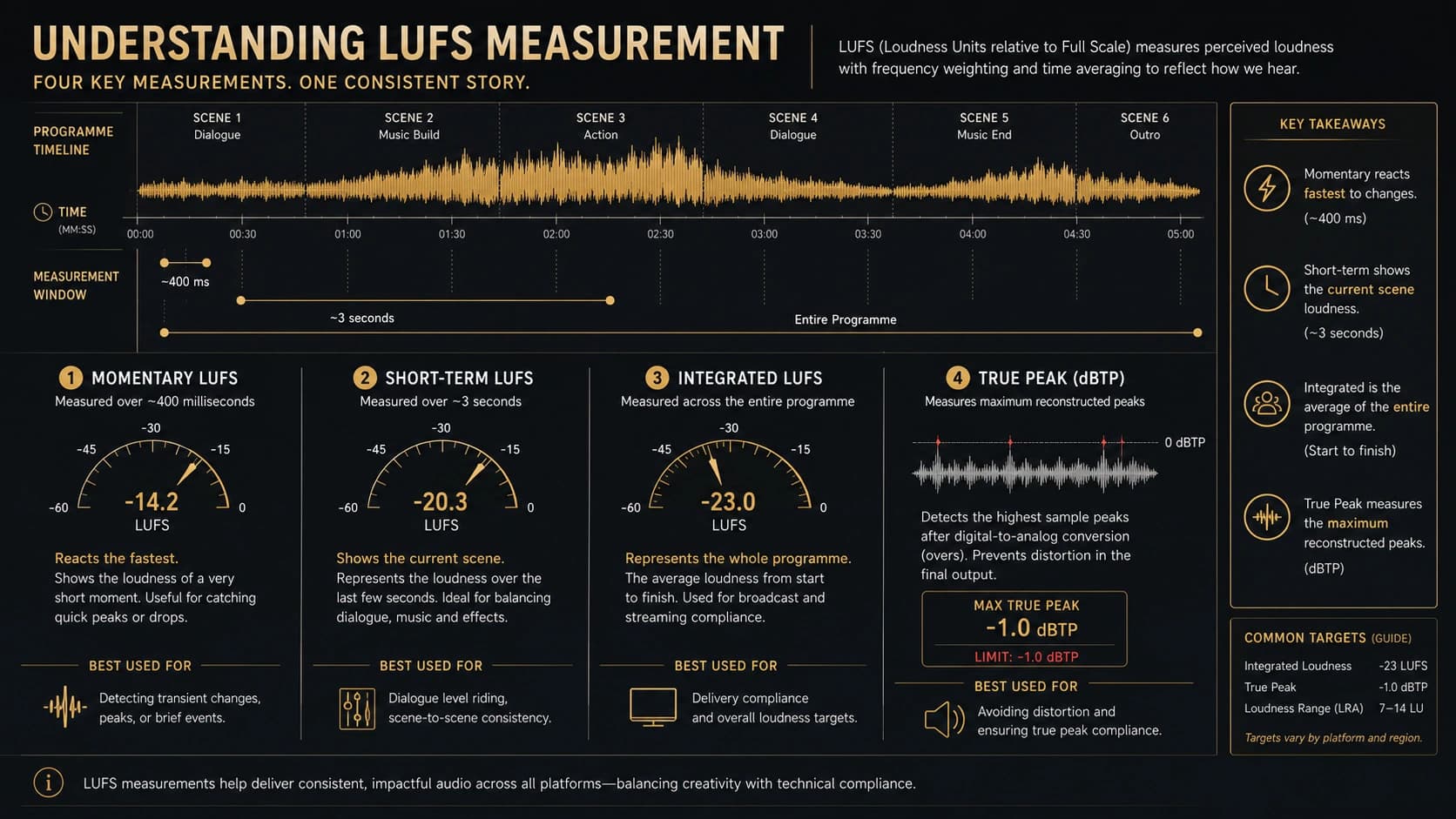
Integrated LUFS
The loudness of the entire program (or measured segment), typically with gating so silence does not drag the number down unfairly. This is the primary number most broadcast specs quote.
Short-term LUFS
A sliding window (commonly about three seconds) used to watch momentary program energy—useful while mixing trailers, montages, or ad beds that spike briefly.
Momentary LUFS
A very short window (commonly about 400 ms) that reveals impact events: hits, whooshes, and sudden dialogue peaks that short-term and integrated meters may smooth over.
LUFS vs RMS: RMS averages power without the BS.1770 loudness weighting and gating rules. Two mixes can share similar RMS yet diverge in LUFS—and only LUFS/LKFS maps cleanly to EBU R128 and ATSC A/85 delivery language.
Why Broadcasters Reject Audio
Automated ingest and human QC both reject masters that violate the published window. Common failure modes include:
- Integrated loudness too high or too low for the channel target
- True peak above the allowed ceiling (often −1 or −2 dBTP)
- Inconsistent dialogue level across scenes or languages
- Clipping, overs, or illegal digital distortion
- Commercials or bumpers dramatically louder than program
- Incorrect normalization (web loudness delivered as “TV ready”)
- Missing stems, wrong channel mapping, or non-compliant layout
Major Loudness Standards
ITU-R BS.1770 defines how loudness and true-peak are measured. Delivery documents then set targets on top of that method.
EBU R128 is the European Broadcasting Union recommendation for programme loudness—typically −23 LUFS integrated with true-peak control near −1 dBTP. See the EBU R128 publication.
ATSC A/85 guides loudness for ATSC digital television in the United States, commonly associated with −24 LKFS programme loudness and true-peak discipline around −2 dBTP. Review ATSC A/85 for the authoritative text.
Netflix and other premium OTT partners publish their own Partner Help specifications—often quieter integrated targets than linear TV, with strict true-peak and dialogue consistency expectations. Always open the current Netflix Partner Help article for the title type you are delivering.
YouTube, Spotify, Apple Podcasts, and Amazon primarily normalize on playback. Their approximate targets matter for creative leveling and codec headroom, but they are not substitutes for broadcast QC specs.
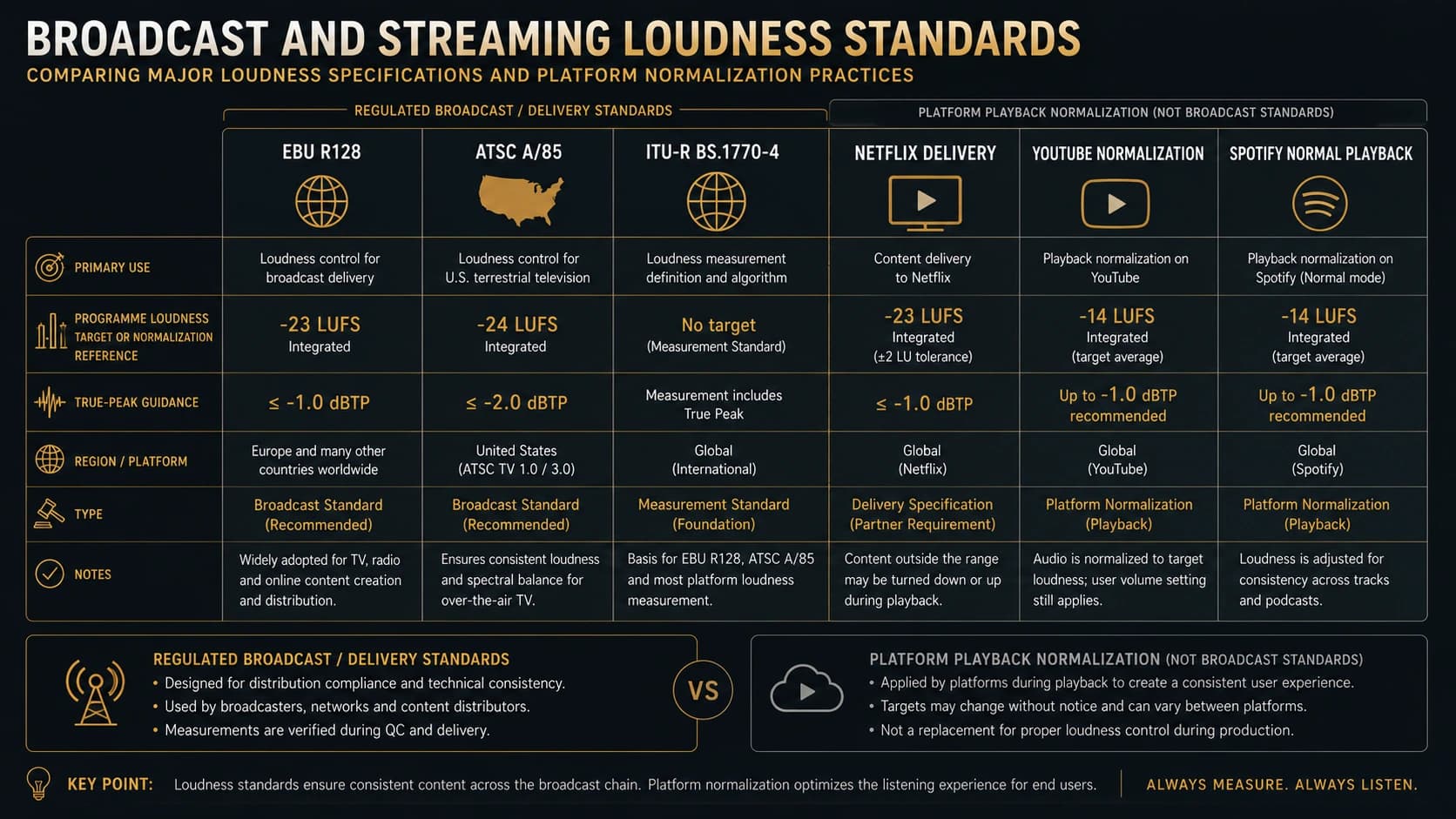
LUFS Targets by Platform
Use this table for planning—not as a replacement for the signed delivery specification on your project.
| Platform | Integrated LUFS | True Peak | Tolerance | Typical Use |
|---|---|---|---|---|
| EBU R128 (broadcast) | −23.0 LUFS | −1.0 dBTP | ±0.5 LU typical | EU / many intl. TV |
| ATSC A/85 (broadcast) | −24.0 LKFS | −2.0 dBTP | Program / dialnorm | US / ATSC TV |
| ITU-R BS.1770 | Measurement basis | Defines TP algorithm | — | Underlying method |
| Netflix (typical) | ≈ −27 LKFS | −2 dBTP common | Per Partner Help | OTT original / scripted |
| YouTube | ≈ −14 LUFS norm. | Often −1 dBTP plan | Platform normalize | Web / social video |
| Spotify (Normal) | ≈ −14 LUFS | Varies by mode | ReplayGain-style | Music streaming |
| Apple Podcasts | ≈ −16 LUFS | Avoid clipping | Show-level target | Podcast delivery |
| Amazon Music | ≈ −14 LUFS class | Platform dependent | Normalize on play | Music streaming |
Values are approximate delivery or normalization targets commonly cited for planning. Always confirm the current specification for your channel, agency, or platform before mastering.
Understanding True Peak
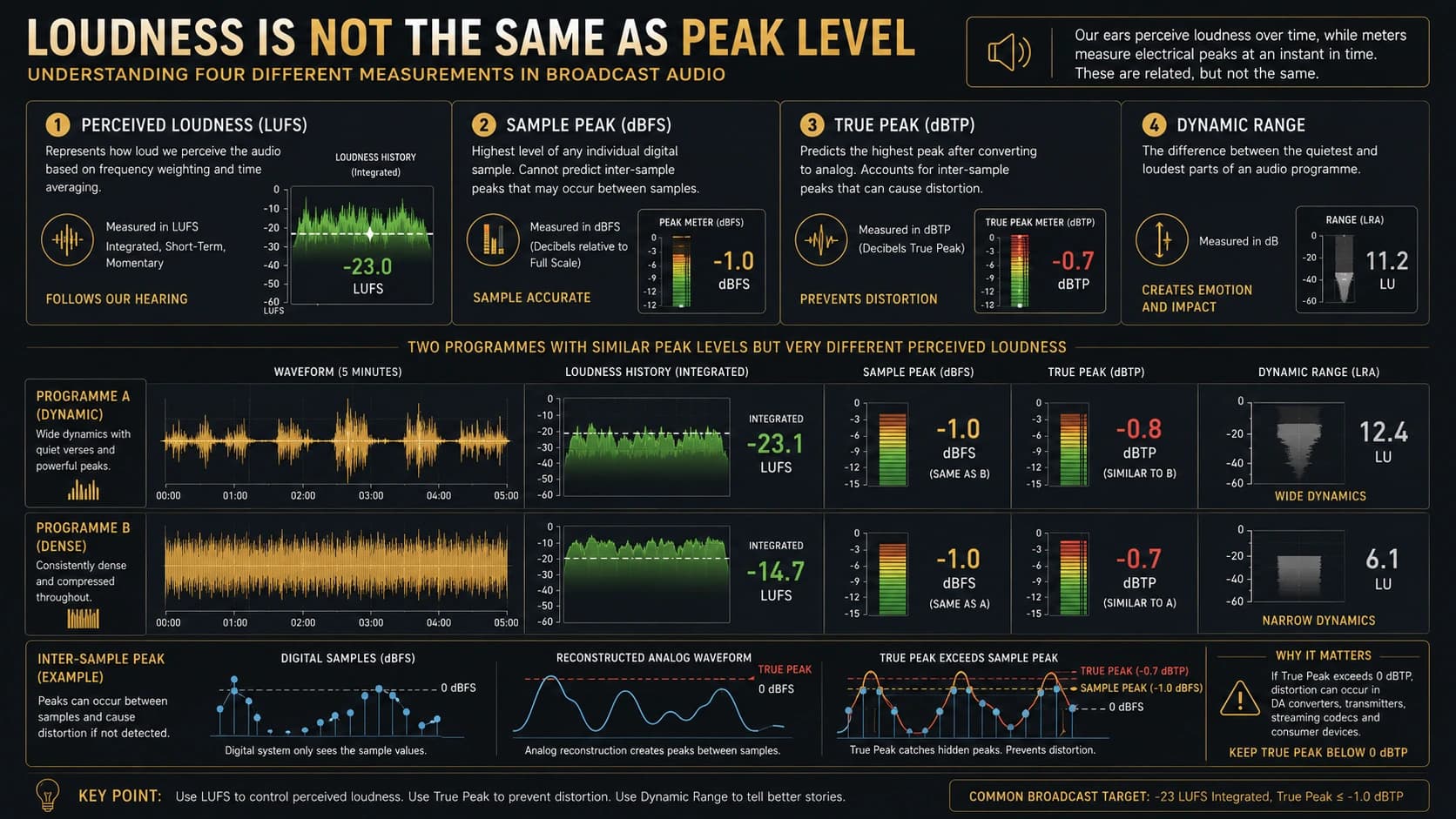
Sample peak is the highest digital sample in the file. True peak estimates peaks that appear between samples when the signal is reconstructed—called inter-sample peaks. Codec encoding, sample-rate conversion, and D/A conversion can all reveal those overs.
That is why a mix can look safe on a sample-peak meter yet fail true-peak QC after ProRes, AAC, or Dolby encode. Limit with true-peak awareness and re-measure the final deliverable, not only the session bus.
Measuring Loudness
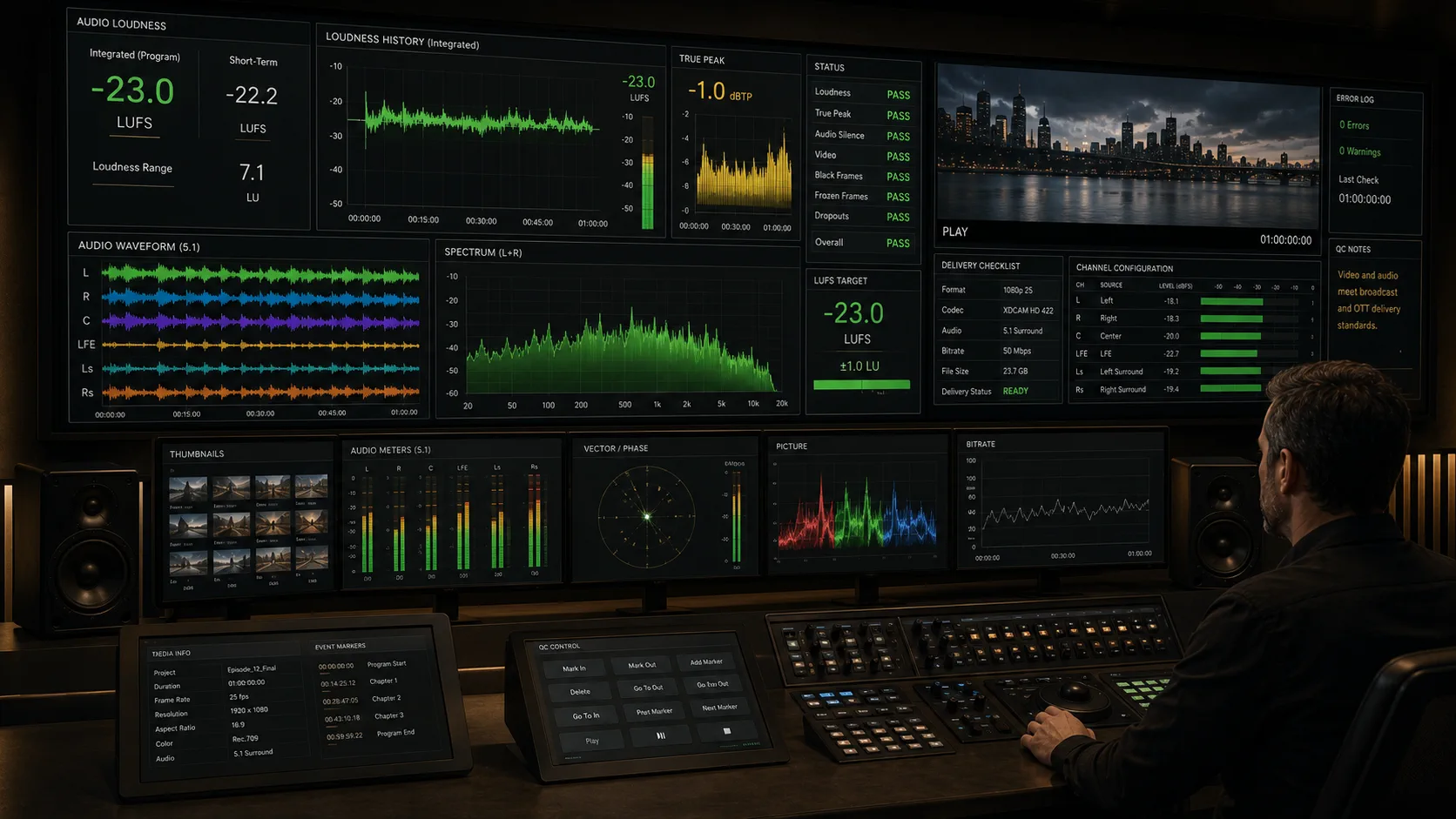
Professional meters implement BS.1770 and expose integrated, short-term, momentary, and true-peak readouts. Common tools in broadcast finishing include NUGEN VisLM / LM-Correct, Waves WLM, Youlean Loudness Meter, Dolby metering and encoding suites, DaVinci Resolve Fairlight meters, Adobe Audition loudness matching, and Avid Pro Tools with compliant metering plugins.
Calibrate against a known reference tone or test program when commissioning a new room. Match meter ballistics and gating to the standard named in the delivery brief (R128 vs A/85 language).
Mixing for Broadcast
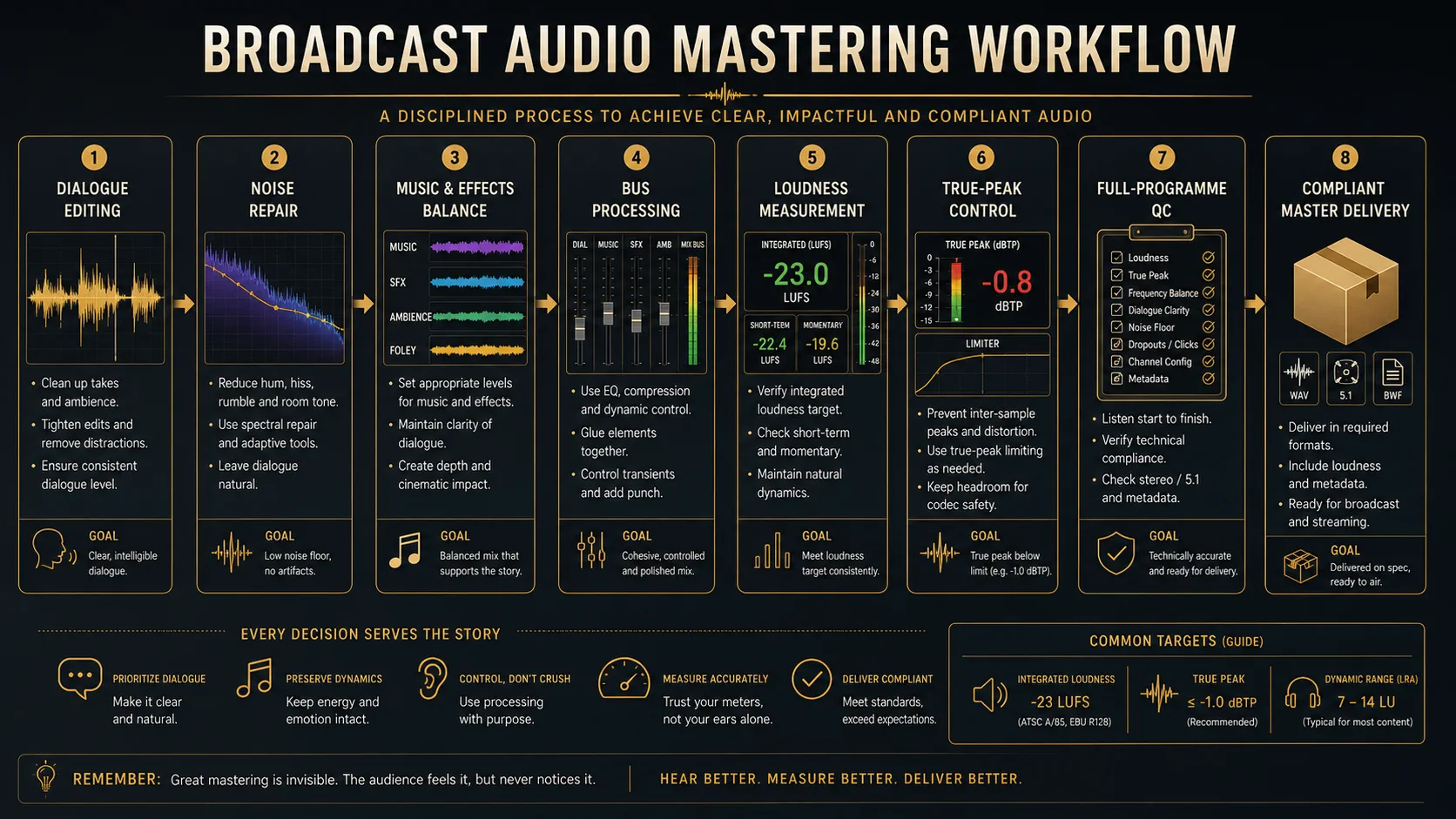
A resilient broadcast mix order keeps dialogue intelligible, music supportive, and peaks legal:
- Dialogue edit and consistency
- Music beds under speech
- Effects and design without masking intelligibility
- True-peak aware limiting on the program bus
- BS.1770 loudness metering (integrated + true peak)
- QC against the delivery specification
- Master delivery and archive
Common LUFS Mistakes
- Over-compression that destroys dynamics yet still fails true peak
- Brickwall limiting to “make it loud” for web, then shipping to TV
- Ignoring dialogue while chasing a single integrated number
- Mixing only on headphones without a calibrated monitoring path
- Exporting the timeline without a final loudness QC pass
- Trusting sample peak while true peak exceeds the ceiling
Broadcast QC Checklist
- Confirm the named standard (EBU R128, ATSC A/85, Netflix, other)
- Measure integrated loudness on the final bounced master
- Verify true peak ≤ specified dBTP on the same master
- Spot-check short-term / momentary for illegal spikes
- Audit dialogue consistency across scenes and languages
- Confirm channel layout, sample rate, and bit depth
- Check for clipping, dropouts, phase, and sync
- Validate commercials / bumpers relative to program level
- Document meter readings in the delivery note
- Archive stems and the approved master with version IDs
OTT vs Broadcast
Linear broadcast prioritizes channel-to-channel consistency and regulatory loudness. Premium OTT often wants quieter integrated targets, pristine true-peak behavior, and dialogue-first mixes for living-room and mobile playback. Consumer platforms may normalize aggressively—so a −14 LUFS web master can still be “correct” for YouTube while failing a −23 LUFS TV handoff.
Never assume one master serves every destination. Plan versioning: broadcast mix, OTT mix, and social cutdowns with separate QC.
How Editors Can Avoid Rejection
- Read the delivery spec before picture lock, not after export
- Keep a calibrated loudness meter on the program bus while editing
- Protect dialogue; duck music early rather than crushing at the end
- Limit with true-peak awareness; leave the required headroom
- Bounce the real deliverable format and re-measure that file
- Run a checklist QC and capture screenshots of meter results
- Label versions clearly so the wrong master never ships
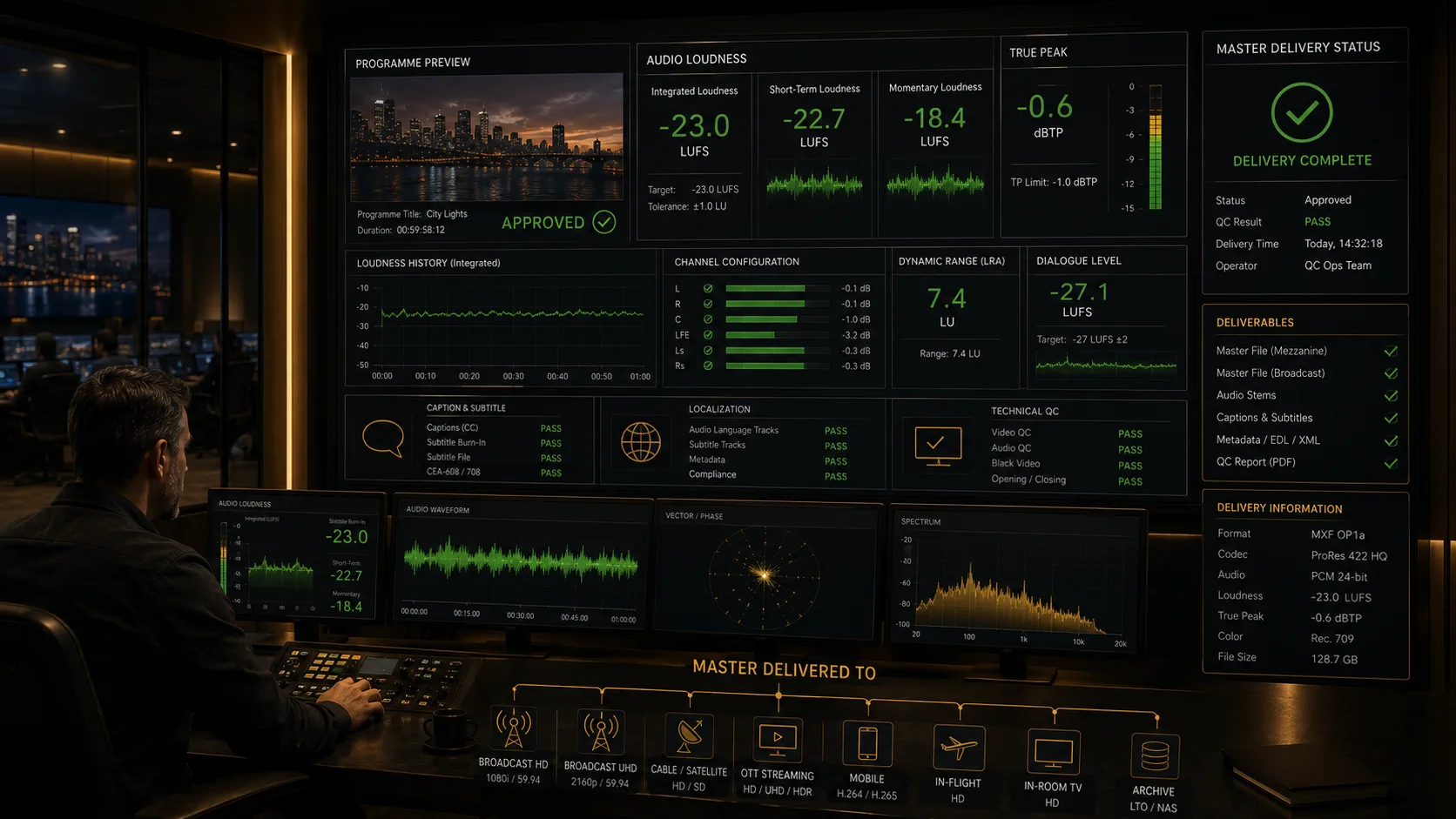
Rendorax Studio Workflow
Rendorax Studio supports production companies, agencies, and broadcasters through audio post-production, broadcast post-production, quality control, localization, OTT finishing, audio compliance checks, and master delivery—so loudness, true peak, and version control stay aligned from mix to handoff.
FAQ
What LUFS target should I use for broadcast TV?
For many European and international deliveries, EBU R128 targets −23 LUFS integrated with a true-peak ceiling near −1 dBTP. US ATSC A/85 workflows commonly target −24 LKFS with a true-peak limit around −2 dBTP. Always follow the channel’s delivery specification.
What is the difference between LUFS and LKFS?
They describe the same loudness scale based on ITU-R BS.1770. LKFS is the term used in ATSC documentation; LUFS is the term used in EBU documentation. Treat −23 LUFS and −24 LKFS as related but specification-specific targets, not interchangeable labels without checking the brief.
Why does true peak matter if sample peaks look fine?
Digital-to-analog conversion and lossy codecs can reconstruct inter-sample peaks higher than the highest sample value. True-peak metering estimates those peaks so limiters and QC can prevent clipping after encode or transmission.
Will YouTube reject my mix if it is not −23 LUFS?
YouTube generally normalizes playback rather than rejecting files for missing −23 LUFS. Broadcast and many OTT partners do enforce loudness and true-peak windows. Match the destination: broadcast specs and Netflix Partner Help differ from consumer streaming normalization.
Should dialogue or full-program loudness drive the mix?
Most broadcast specs care about integrated program loudness (with gating as defined by the standard). Dialogue still anchors perceived loudness—if dialogue is inconsistent, the program can fail QC even when the integrated number looks close.
What is a safe true-peak ceiling before delivery?
Many broadcast and premium OTT specs require ≤ −1 dBTP or ≤ −2 dBTP. When the brief is unclear, planning a limiter ceiling of −2.0 dBTP is a conservative starting point—then verify against the exact delivery document.
References and Further Reading
- ITU-R BS.1770 — Algorithms to measure audio programme loudness and true-peak audio level
- EBU R128 — Loudness normalisation and permitted maximum level of audio signals
- ATSC A/85 — Techniques for Establishing and Maintaining Audio Loudness for Digital Television
- Netflix Partner Help — Delivery and audio specifications hub
- Dolby Professional — Broadcast and streaming audio resources
- Adobe Audition — Match loudness
- Blackmagic Design — DaVinci Resolve Fairlight
- BBC Academy — Broadcast craft and training resources